
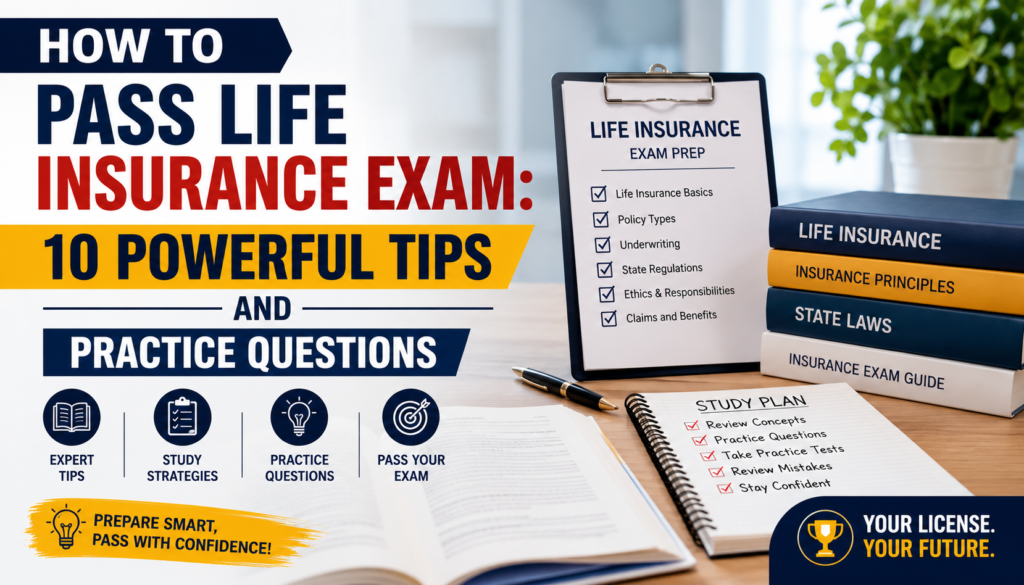
How To Pass Life Insurance Exam: 10 Powerful Tips and Practice Questions
Learning about the Life Insurance Exam
One of the most significant steps to becoming a licensed insurance agent in the United States is passing the life insurance exam. A life insurance license opens the door to many career paths, whether you want to build a career in life insurance, desire to assist families in securing their financial future, or are seeking to work in the expanding insurance industry.
But many people underestimate the life insurance exam. The test is not doable, but it does require preparation, discipline, and knowledge of insurance concepts and state regulations.
Each year, thousands of applicants are looking on the internet for:
• How to pass the life insurance exam
Examples of life insurance questions.
Test-taking tips for the Life Insurance Exam.
These are the best study methods for the best life insurance.
Fortunately, when you understand, passing the exam becomes much easier:
✔️ How the exam works
✔️ What is taught
✔️Popular Error Analysis – Common Errors in L2 Writing (CELW) error types
✔️ Smart study strategies
✔️ Practice question techniques
In this guide, we shall clarify the exam framework, the reasons many people fail, and the initial strategies vital to success.
What is the Life Insurance Exam?
The life insurance exam is a USA licensing exam for those wanting to lawfully sell life insurance products.
The exam tests candidates’ comprehension of:
• Insurance fundamentals
The laws and regulations of the state.State law and regulations.
• Ethics
• Policy types
• Underwriting
• Consumer protection rules
The exam measures a candidate’s knowledge and ability to make a responsible recommendation to clients regarding life insurance coverage.

The exam tests your knowledge of:
✔️ Life insurance basics
✔️ Policy types
✔️ Underwriting concepts
✔️ State insurance laws
✔️ Ethics and compliance
✔️ Beneficiaries and claims
What is the rationale behind taking the Life Insurance Exam?
Life insurance agents sell vital financial products that impact:
✔️ Families
✔️ Retirement planning
✔️ Funeral protection
✔️ Estate planning
✔️ Long-term financial security
States mandate that insurance agents pass insurance licensing exams, since they entail legal and financial obligations.
Who Needs to Take the Life Insurance Exam?
Typically, the exam will be requested for:
• Insurance agents
• Insurance brokers
• Financial professionals
• Independent insurance producers
Anyone who would like to sell:
✔️ Term life insurance
✔️ Whole life insurance
✔️ Universal life insurance
✔️ Final expense insurance
You normally have to successfully complete a state exam to make it in the first place.
State Licensing Requirements in the USA
Each state has different requirements for life insurance licenses.
Each state has its own:
• Licensing department
• Exam provider
• Passing score requirements
• Pre-licensing education rules
But in most states, insurance ideas and regulations are tested in a similar manner.
Common State Requirements
Many states require:
✔️ Pre-licensing education courses
✔️ Fingerprinting or background checks
✔️ Passing the licensing exam
•••••• License applications and fees (1.0/1.0)
States also may mandate ongoing education following licensure.
Knowing the format of the Life Insurance exam.
Knowing the exam format is one of the best test tips for life insurance success.
The following are typically part of the most common life insurance exams:
✔️ Multiple-choice questions
✔️ Timed testing sessions
✔️ State-specific content
✔️ National insurance concepts
The number of questions will depend on the state.
Typical Exam Structure
Most exams contain:
• 50–150 questions
• Multiple-choice format
Time limits of 1 – 3 hours
Typically, the test will consist of the following:
✔️ National insurance topics
✔️ State insurance laws
Computer-Based Testing
Life insurance exams are now computer-based and are offered at designated test sites.
Candidates should be prepared to:
• Register online
• Schedule appointments
• Bring identification documents
Some states may allow remote testing.
The Life Insurance exam covers a variety of topics.
Some important topics are discussed on the life insurance exam.
Passing these subjects requires knowledge of them.
Insurance Basics
Candidates must understand:
✔️ Risk management
✔️ Insurance principles
✔️ Policy contracts
✔️ Premium concepts
There are other, more complicated topics, and they all build on basic insurance knowledge.
There are different types of life insurance policies to look for.
The exam typically covers content on:
• Term life insurance
• Whole life insurance
• Universal life insurance
• Variable life insurance
Candidates should understand:
✔️ Policy differences
✔️ Coverage duration
✔️ Cash value features
✔️ Premium structures
Beneficiaries, Policy Ownership.
The exam can contain questions about:
• Beneficiary designations
• Policy ownership rights
• Death benefit payments
• Policy assignments
These concepts are relevant and impactful to policyholders and families.
Underwriting
One of the most significant exam topics is underwriting.
Candidates should understand:
✔️ Risk evaluation
✔️ Health assessments
✔️ Premium determination
✔️ Policy approval factors
Underwriting is used by insurance companies to discover:
• Eligibility
• Risk level
• Pricing
State Insurance Laws and Ethics
All states have questions about:
• Insurance regulations
• Ethical responsibilities
• Consumer protection laws
• Fraud prevention
When selling policies, agents are required to be responsible, and therefore, ethics questions are particularly important.
Why Many People Fail the Life Insurance Exam
The problem is that many candidates don’t prepare properly for the exam, but it’s not impossible to prepare and pass it.
It can help you a lot if you know the common errors.
Lack of Preparation
This is one of the primary reasons that people fail.
Some students assume:
The test will be easy:⚠️
One would assume the concepts of insurance would be simple, but they are not.
🚨 There’s no need to study late!
Unfortunately, the exam covers detailed concepts and regulations that require constant preparation.
Memorizing Without Understanding
Students attempt to learn by rote, without grasping the concepts.
This approach has often been unsuccessful due to the fact that:
Questions may be restated in other ways.
Situational scenarios call for understanding.
• Concepts are interconnected
Successful learners will be concentrating on:
✔️ Understanding insurance principles
✔️ Applying knowledge logically
In addition to memory.
Ignoring Practice Questions
A lot of significance is given to practice questions.
Students who do not take practice exams may find difficulty with:
⚠️ Time management
⚠️ Question wording
⚠️ Test pressure
Candidates will get to know the practice tests and how they are structured:
✔️ Exam structure
✔️ Common question patterns
✔️ Time limitations
Poor Study Habits
The variable study habits can decrease retention and confidence.
Poor habits include:
Last-minute cramming, there is no point in doing this.
⚠️ Skipping difficult topics
🚧Learning on Sight
Strong preparation requires:
✔️ Daily review
✔️ Consistent repetition
✔️ Organized study plans
Test Anxiety and Stress 5.
Some candidates know what to do but aren’t coping with exam anxiety.
Stress can affect:
• Memory recall
• Focus
• Confidence
• Time management
It’s as important to prepare mentally as it is to study.
The following information will be helpful in preparing for the Life Insurance Exam:
The key to success in preparation is organization and consistency.
Create a Study Plan
The best is to make a plan to study.
The following is a list of the key elements of good study plans:
✔️ Daily review sessions
✔️ Practice questions
✔️ Topic-based study goals
✔️ Weekly progress tracking
Preparation is key to great retention.
A structured study schedule helps you:
✔️ Stay organized
✔️ Improve focus
✔️ Manage study time effectively
✔️ Reduce exam stress
✔️ Build confidence before test day
Divide topics into smaller sections.
Trying to learn a lot in one go may be daunting.
Rather, organize material by categories like:
• Insurance basics
• Policy types
• State regulations
• Ethics
• Underwriting
Learning in smaller bites means understanding and concentration.
Take advantage of multiple study resources.
Concepts are reinforced by using different learning methods.
Useful study aids:
✔️ Study guides
✔️ Flashcards
✔️ Practice exams
✔️ Video lessons
✔️ Pre-licensing courses
Multiple formats help to retain information.
Importance of Practice Exams
One of the best ways to prepare for an exam is by practicing tests.
They help candidates:
✔️ Identify weak areas
✔️ Improve confidence
✔️ Practice time management
✔️ Understand question formats
Students typically feel more at ease with the actual exam after completing more practice questions.
Knowing the basics of life insurance terminology.Knowing the fundamentals of life insurance terminology.
There is a lot of insurance terminology tested on this examination.
Candidates should have an appreciation of the following terms:
• Premium
• Beneficiary
• Insured
• Underwriting
• Rider
• Death benefit
• Cash value
• Grace period
Understanding the vocabulary aids understanding and test scores.
Importance of Consistency
Consistency is one of the most important test tips that you can use in order to succeed with life insurance.
A little bit each day is often more productive than:
⚠️ Last-minute cramming
Long but infrequent study sessions.
Repeated review will transfer information to long-term memory.
Building Confidence before Test Day
High self-confidence leads to high performance.
To build confidence, candidates can:
✔️ Completing practice exams
✔️ Reviewing weak topics
✔️ Tracking progress
✔️ Understanding core concepts
Preparation decreases stress and increases preparedness.
In closing, take some time to review and reflect on the preparation for the life insurance exam.
Studying to pass the life insurance exam requires a bit of preparation, consistency, and knowledge of insurance concepts and regulations.
Candidates who understand:
✔️ The exam structure
✔️ Common mistakes
✔️ Study strategies
✔️ Practice question techniques
Be much more confident and prepared on test day.
It’s not about memorizing random answers to succeed. It is the knowledge of life insurance and its proper application while taking the exam.
How to Pass Life Insurance Exam: 10 Powerful Tips and Practice Questions
In Part 2, we cover 10 powerful tips to pass the life insurance exam.
You should not simply memorize the answers to the life insurance exam. The exam is designed to assess knowledge of insurance concepts, regulations, ethics, and structures of policies. The fact that many candidates underestimate the importance of preparation and proper study techniques is the reason why they lose.
The beauty of the situation is that thousands of students prepare, practice, and pass the exam every year.
Whether you are taking a life insurance exam for the first time or a retake, the following are some proven test tips for life insurance that can boost:
✔️ Confidence
✔️ Knowledge retention
✔️ Test performance
✔️ Time management
✔️ Passing rates
Let’s look at 10 powerful tips that can help you pass the life insurance exam in the USA with a successful strategy.
The first step is to familiarize yourself with the Exam Structure.
The worst fatal error is studying without understanding the exam.
The first step in learning is to open up your study materials.
✔️ Number of questions
✔️ Time limits
✔️ Passing score requirements
✔️ State-specific rules
✔️ Topic breakdowns
The structure helps to minimize confusion and anxiety later.
Why Understanding the Exam Matters
Once students are familiar with the exam format, they can:
Improve study time management
• Practice the most commonly tested topics
• Develop realistic preparation plans
The majority of life insurance exams include:
• Multiple-choice questions
• National insurance topics
• State insurance laws
Familiarize Yourself with Your State Requirements
Various states can have:
⚠️ Different passing scores
⚠️ Different question counts
⚠️ Different licensing rules
Before scheduling the exam, be sure to check with your state insurance department’s website.
Establish a regular and steady study plan.
One of the most crucial elements to passing the life insurance exam is consistency.
It is generally a lot more beneficial to study a little each day than:
⚠️ Last-minute cramming
Spending long and irregular study time
The advantages of a Study Schedule
Having a plan helps:
✔️ Improve memory retention
✔️ Reduce stress
✔️ Build confidence
✔️ Prevent burnout
Example Weekly Study Plan
A balanced schedule can contain:
• 1–2 hours daily
• Topic-based review sessions
• Practice question time
• Weekly progress checks
Avoid Procrastination
Sometimes there is an increase in waiting until the last week:
⚠️ Anxiety
⚠️ Confusion
⚠️ Information overload
Regularly applying study skills will lead to deeper comprehension in the long term.
Pay attention to the key life insurance principles.
The exam is not for memorization but for comprehension.
The candidates need to know the following concepts of insurance:
✔️ Premiums
✔️ Beneficiaries
✔️ Underwriting
✔️ Riders
✔️ Cash value
✔️ Death benefits
The following topics appear repeatedly on the exam.
Grammar and how policies work.Grammar and understanding of how policies work.
Candidates should understand:
The major differences between various types of policies.The key differences between policies.
How premiums are determined.
What factors can impact underwriting decisions? What influences underwriting decisions?
The manner in which claims are paid.The way claims are settled.
The most important types of policies to study are shown.
Focus heavily on:
✔️ Term life insurance
✔️ Whole life insurance
✔️ Universal life insurance
✔️ Variable life insurance
Many Life insurance question examples require an understanding of the differences in policy.
Take Practice Exams regularly.
One of the best ways to prepare for the real exam is to take practice tests.
In many successful candidates, the completion of the following is observed:
✔️ Multiple complete practice tests
✔️ Daily practice questions
✔️ Timed quizzes
Practicing questions is important for a range of reasons.
Using a practice exam will assist candidates in:
• Learn question patterns
• Improve speed
• Identify weak areas
• Reduce exam anxiety
The more comfortable you feel with practice questions, the more comfortable the actual exam will be.
Simulate Real Testing Conditions.
Try practicing:
✔️ Under timed conditions
✔️ Without distractions
✔️ Incorporating and applying realistic exam formats
This helps to prepare the mind and focus.
Look over the incorrect answers carefully.
A good study method is to look at errors.
Don’t learn the right answers by rote.
Instead, understand:
✔️ Why the answer is correct
Other answers are incorrect for the following reason(s):
This enhances conceptual learning.
Know the State Insurance Laws and Regulations.
Students are only interested in the insurance product and lose sight of state law.
But state laws are being challenged.
Topics Likely To Be Incorporated In State Sections
Common topics include:
✔️ Licensing laws
✔️ Ethics requirements
✔️ Consumer protection rules
✔️ Fraud prevention
✔️ Agent responsibilities
How do Ethics Questions fit into this? How do Ethics Questions fit into this?
The responsibility of insurance agents is legal, and they must:
• Protect consumers
• Provide accurate information
• Avoid unethical behavior
Ethical scenarios are featured in many exam questions.
Study State-Specific Material Carefully
State law sections will differ from state to state.
Do not ignore:
⚠️ State regulations
⚠️ Licensing procedures
⚠️ Insurance department rules
These questions can have a huge impact on your final grade.
In this step, it is crucial to learn about the various types of life insurance policies. In this step, it’s important to know about life insurance policies.
One of the most crucial components of the life insurance exam is comprehension of the difference between policies.
Term Life Insurance
Candidates should know:
✔️ Temporary coverage
✔️ Lower premiums
✔️ No cash value
✔️ Fixed coverage periods
Whole Life Insurance
These are the types of whole life policies:
✔️ Lifetime protection
✔️ Fixed premiums
✔️ Cash value accumulation
Universal Life Insurance
Important concepts include:
✔️ Flexible premiums
✔️ Adjustable death benefits
✔️ Interest accumulation
Variable Life Insurance
Candidates should understand:
✔️ Investment components
✔️ Market risk
✔️ Cash value fluctuations
Comparing different types of policies is a typical exam question.
Master Insurance Vocabulary
The exam contains a lot of insurance terminology.
Vocabulary is enhanced:
✔️ Reading comprehension
✔️ Speed
✔️ Accuracy
There are some terms that are important to understand when it comes to insurance.
Candidates will be expected to know the following words:
• Beneficiary
• Insured
• Annuity
• Rider
• Underwriting
• Premium
• Grace period
• Policy loan
• Cash value
• Face amount
Use Flashcards for Vocabulary Practice
Flashcards help with:
✔️ Quick review
✔️ Memory reinforcement
✔️ Repetition-based learning
Either a digital app or physical flashcards work well.
Explain words and phrases used in their correct context.
Avoid simply memorizing definitions.
Understand:
✔️ Actual policy wording terms clarified.
Concepts are the key to making money. There is a financial reason for concepts.
Including context makes a huge difference to retention.
Improve Test-Taking Skills
Aural tests can be improved with effective test-taking strategies, even for candidates who are familiar with the material.
Read Questions Carefully
There are many reasons why students might get this question wrong, including that they:
⚠️ Read too quickly
⚠️ Miss important words
⚠️ Misinterpret scenarios
Take your time and be very careful.
Eliminate Wrong Answers First
If in doubt, eliminate the obviously wrong answers.
This makes it more likely that the selected response will be the answer that makes sense.
Manage Time Wisely
Avoid devoting excessive time to a challenging question.
Instead:
Answer the easier questions first ✔️
✔️Highlight challenging questions to be reviewed
If necessary, come back later.
Avoid Second-Guessing Yourself
Do not change answers when it is not necessary to do so to gain higher marks.
Only change answers if:
✔️ You find a definite error
✔️ You misunderstood the question initially
Ease Exam Stress & Exam Anxiety
A large number of students are familiar with the content but are stressed and, as a result, having trouble.
Anxiety can have a negative impact on:
⚠️ Focus
⚠️ Confidence
⚠️ Memory recall
It’s crucial to get mentally ready.
Sleep Well The Night Before the Exam!
Sleep improves:
✔️ Memory
✔️ Concentration
✔️ Problem-solving ability
Do not study for long periods without taking breaks.
Use Relaxation Techniques
Helpful strategies include:
• Deep breathing
• Positive visualization
Choose and allocate a short break during study sessions (optional)
Reducing stress helps to improve performance.
Rehearse, rehearse, rehearse. Practice, practice, practice.
Candidates build their confidence as they:
✔️ Complete practice exams
✔️ Understand key concepts
✔️ Follow consistent study routines
One of the most effective ways to minimize fear is to get ready.
Complexities of Test Day.
There should be a strong emphasis on review and reinforcement during the last few days before the test.
The value of Final Review Sessions.
Review helps:
✔️ Strengthen memory
✔️ Refresh weak topics
✔️ Improve confidence
Focus especially on:
• Difficult concepts
• State laws
• Policy comparisons
• Vocabulary
Repetition Improves Retention
Multiple questions from similar types of Life insurance are seen over and over again:
✔️ Recognition speed
✔️ Accuracy
📝Write down during the exam
Don’t learn totally new material at the last minute.
Final review days are intended to refresh ideas, never confuse them!
Focus on:
✔️ Reviewing notes
✔️ Practicing questions
✔️ Strengthening weak areas
Rather than taking on new ideas on steroids.
Best Study Materials for Life Insurance Exam.
Good preparation can be achieved through using good study materials.
Useful Study Materials:
✔️ Pre-licensing courses
✔️ Practice exam websites
✔️ Insurance textbooks
✔️ Flashcards
✔️ Video lessons
✔️ Mobile apps
There are several different learning styles, and therefore several different resources that are beneficial to each.
Strong study resources help students:
✔️ Understand insurance concepts
✔️ Improve memory retention
✔️ Practice exam questions
✔️ Build confidence before test day
✔️ Identify weak study areas
Importance of Practice Questions
These are some of the best ways to prepare, as practice questions:
✔️ Simulate real testing
✔️ Improve confidence
Develop familiarity with wording.
The candidates should work through numerous practice questions prior to the test date.
The following are examples of common mistakes to avoid:
A large number of students fail due to avoidable mistakes.
Universal Life Insurance
Important concepts include:
✔️ Flexible premiums
✔️ Adjustable death benefits
✔️ Interest accumulation
Variable Life Insurance
Candidates should understand:
✔️ Investment components
✔️ Market risk
✔️ Cash value fluctuations
Comparing different types of policies is a typical exam question.
Master Insurance Vocabulary
The exam contains a lot of insurance terminology.
Vocabulary is enhanced:
✔️ Reading comprehension
✔️ Speed
✔️ Accuracy
There are some terms that are important to understand when it comes to insurance.
Candidates will be expected to know the following words:
• Beneficiary
• Insured
• Annuity
• Rider
• Underwriting
• Premium
• Grace period
• Policy loan
• Cash value
• Face amount
Use Flashcards for Vocabulary Practice
Flashcards help with:
✔️ Quick review
✔️ Memory reinforcement
✔️ Repetition-based learning
Either a digital app or physical flashcards work well.
Explain words and phrases used in their correct context.
Avoid simply memorizing definitions.
Understand:
✔️ Actual policy wording terms clarified.
Concepts are the key to making money. There is a financial reason for concepts.
Including context makes a huge difference to retention.
Improve Test-Taking Skills
Aural tests can be improved with effective test-taking strategies, even for candidates who are familiar with the material.
Read Questions Carefully
There are many reasons why students might get this question wrong, including that they:
⚠️ Read too quickly
⚠️ Miss important words
⚠️ Misinterpret scenarios
Take your time and be very careful.
Eliminate Wrong Answers First
If in doubt, eliminate the obviously wrong answers.
This makes it more likely that the selected response will be the answer that makes sense.
Manage Time Wisely
Avoid devoting excessive time to a challenging question.
Instead:
Answer the easier questions first ✔️
✔️Highlight challenging questions to be reviewed
If necessary, come back later.
Avoid Second-Guessing Yourself
Do not change answers when it is not necessary to do so to gain higher marks.
Only change answers if:
✔️ You find a definite error
✔️ You misunderstood the question initially
Ease Exam Stress & Exam Anxiety
A large number of students are familiar with the content but are stressed and, as a result, having trouble.
Anxiety can have a negative impact on:
⚠️ Focus
⚠️ Confidence
⚠️ Memory recall
It’s crucial to get mentally ready.
Sleep Well The Night Before the Exam!
Sleep improves:
✔️ Memory
✔️ Concentration
✔️ Problem-solving ability
Do not study for long periods without taking breaks.
Use Relaxation Techniques
Helpful strategies include:
• Deep breathing
• Positive visualization
Choose and allocate a short break during study sessions (optional)
Reducing stress helps to improve performance.
Rehearse, rehearse, rehearse. Practice, practice, practice.
Candidates build their confidence as they:
✔️ Complete practice exams
✔️ Understand key concepts
✔️ Follow consistent study routines
One of the most effective ways to minimize fear is to get ready.
Complexities of Test Day.
There should be a strong emphasis on review and reinforcement during the last few days before the test.
The value of Final Review Sessions.
Review helps:
✔️ Strengthen memory
✔️ Refresh weak topics
✔️ Improve confidence
Focus especially on:
• Difficult concepts
• State laws
• Policy comparisons
• Vocabulary
Repetition Improves Retention
Multiple questions from similar types of Life insurance are seen over and over again:
✔️ Recognition speed
✔️ Accuracy
📝Write down during the exam
Don’t learn totally new material at the last minute.
Final review days are intended to refresh ideas, never confuse them!
Focus on:
✔️ Reviewing notes
✔️ Practicing questions
✔️ Strengthening weak areas
Rather than taking on new ideas on steroids.
Best Study Materials for Life Insurance Exam.
Good preparation can be achieved through using good study materials.
Useful Study Materials:
✔️ Pre-licensing courses
✔️ Practice exam websites
✔️ Insurance textbooks
✔️ Flashcards
✔️ Video lessons
✔️ Mobile apps
There are several different learning styles, and therefore several different resources that are beneficial to each.
Importance of Practice Questions
These are some of the best ways to prepare, as practice questions:
✔️ Simulate real testing
✔️ Improve confidence
Develop familiarity with wording.
The candidates should work through numerous practice questions prior to the test date.
The following are examples of common mistakes to avoid:
A large number of students fail due to avoidable mistakes.
Explanation:
An underwriter will assist an insurance company in assessing:
• Health risks
• Lifestyle risks
• Financial risks
During the underwriting process, the following will be determined:
✔️ Eligibility
✔️ Premium pricing
✔️ Coverage approval
Which type of insurance policy is best for you? Which is better, Term or Whole Life insurance?
Question:
What kind of life insurance accumulates cash value?
B. Whole life insurance
B. Travel insurance
C. Whole life insurance.
D. Disability insurance
Correct Answer:
✔️ C. Whole life insurance
Explanation:
The following are included in whole life insurance:
✔️ Lifetime coverage
✔️ Fixed premiums
✔️ Cash value accumulation
Term insurance does not accumulate cash value and offers short-term coverage.
During the grace period, what will happen?
Question:
Why is there a grace period for a life insurance policy?
A. To increase coverage
C. To accommodate a late premium payment plan.D. To make it possible to pay a premium late.
To cancel the beneficiaries C. To cancel beneficiaries
A. To increase cash value.
Correct Answer:
✔️ B. To allow late premium payments
Explanation:
The grace period provides policyholders with additional time to pay premiums after their due date, without penalty, to extend coverage.
Which Policy has flexible premiums?
Question:
Often, which type of life insurance policy permits flexible premium payments?
A. Term life
B. Whole life
C. Universal life
D. Credit insurance
Correct Answer:
✔️ C. Universal life
Explanation:
Universal life insurance usually includes the ability to:
✔️ Flexible premiums
✔️ Adjustable death benefits
✔️ Interest accumulation
Other short practice questions.
Question:
Who is insured against life insurance?
✔️ Insured family members
Question:
What was the loss that occurred?
The funds are distributed to the beneficiaries upon the insured’s death.
Question:
What is a policy rider?
An optional coverage that provides additional coverage or benefits under a policy.
Question:
What is the shorter-term cover?
✔️ Term life insurance
Question:
What does cash value mean?
✔️Life insurance’s savings feature is in some types of permanent life insurance.
Why do practice questions help increase passing scores? Why does the use of practice questions help to increase passing scores?
Taking practice exams is very useful since it allows students to:
✔️ Recognize patterns
✔️ Build speed
✔️ Understand wording styles
✔️ Improve confidence
Students don’t practice applying concepts in test-like formats and therefore fail the tests.
Review the following tips on how to use practice tests most effectively.
The following are guidelines for how best to use practice exams:
✔️ Simulate real testing conditions
Carefully check over wrong answers
✔️ Track weak topics
✔️ Practice consistently
Don’t Just Memorize Questions –
Avoid rote-learning the answers to practice tests.
Instead, focus on:
✔️ Understanding concepts
The students will understand why the answers are correct.
Using reasoning in various situations
Questions in the actual exam may be worded differently.
On Exam Day:
There are many important factors to consider when preparing for the exams.
Even the best candidates can falter if they are unprepared or disorganized during an interview.
Arrive Early
Candidates should:
✔️ Arrive early
✔️ Bring required identification
✔️ Confirm the address of the testing site in advance
Students should not miss the deadline, as that can make them anxious or cause them to sit the exam.
Bring Required Documents
Typically, testing centers require:
• Government-issued ID
• Registration confirmation
Paperwork for licensing (if applicable)
Never assume what tests are required – always check first.
How to keep cool during challenging inquiries.
All tests have questions that are a bit difficult.
If you have challenging questions:
✔️ Stay calm
✔️ Eliminate incorrect answers
✔️ Move forward if stuck
If necessary, come back later.
Don’t be alarmed at one question.
Time Management During the Exam
Time management is a key aspect.
Helpful strategies include:
✔️ Answer easy questions first
Don’t take too long on any one thing.
✔️ Review unanswered questions later
Do not rush at the end; finish calmly.
Read Questions Carefully
Many errors are made when candidates:
⚠️ Misread questions
⚠️ Miss keywords
⚠️ Rush through wording
With careful reading, accuracy can be greatly enhanced.
Before submitting, check the answers to ensure the right spelling and grammar.
If time remains:
✔️ Recheck flagged questions
✔️ Confirm unanswered items
✔️ Review difficult sections
But don’t change your answers for no good reason.
What happens after the life insurance exam?
Success in the exam is a great achievement, but in most cases, there are additional steps before obtaining a full license.
Inquire with the insurance company about obtaining a license.
Most states require:
✔️ License applications
✔️ Fees
✔️ Background checks
✔️ Fingerprinting
There are differences in licensing approvals between states.
Work for an Insurance Company/Agency
Once licensed, agents can:
• Join insurance agencies
• Work independently
• Partner with brokerages
• Sell various types of insurance.
Learn and Train on Going
Effective insurance agents always strive to improve:
✔️ Sales skills
✔️ Product knowledge
✔️ State regulation understanding
✔️ Customer communication abilities
There are continuing education needs for careers in insurance.
What are the employment opportunities following licensing? What jobs can be pursued following licensure?
Licensed agents are allowed to operate in:
• Life insurance sales
• Financial planning
• Retirement planning
• Final expense insurance
• Independent brokerage businesses
Insurance companies have numerous opportunities for career advancement.
Frequently Asked Questions (FAQs)
How hard is the life insurance exam?
The exam can be difficult to pass without studying, but many people do pass if they study and practice with exam preparation questions.
How many days/weeks should I study?
Most pupils study for:
✔️ Several weeks
✔️ 1–2 hours daily
It’s better to be consistent than to cram.
Are practice tests important?
Yes. Using practice exams will help you to strengthen:
✔️ Confidence
✔️ Time management
Expression of knowledge on types of questions.
What is the required mark to pass?
Passing scores differ by state, but many states call for about:
✔️ 70% or higher
Are there any opportunities for a retake if I do not pass?
Yes. Most states require retesting after waiting periods, and there may be additional fees.
How to lessen Exam Stress?
Helpful strategies include:
✔️ Practice exams
✔️ Good sleep
✔️ Consistent preparation
✔️ Positive mindset
Final Thoughts
Life insurance exam preparation, consistency, and smart study techniques are what’s needed to pass the exam. People who know insurance concepts and practice regularly, and how the insurance exam is conducted, tend to do very well and feel confident on test day.
Practice questions, developing test-taking techniques, and reviewing key insurance concepts can boost pass rates.
The secret of passing is not simply answering random questions — it’s knowing the fundamentals of life insurance and then putting them to use with confidence on the test.
If you are willing to make the effort, take the time to prepare, practice, and be disciplined enough to pass the life insurance exam and start a rewarding career in the insurance industry.